Tree-Mounted Automatic Rubber Tapping Machine (fixed type)
One machine is installed on one rubber tree and taps it automatically on a preset program. This page gives product specifications, what published studies report, and the conditions that determine configuration and quotation.
What is it, in brief?
The tree-mounted machine works on one tree on a preset program, about 47 s per tree (product specification). Its value comes from many machines working in parallel under local LoRa group control, which needs no 4G/5G on each unit. Indicative price is about RMB 500 per standard unit (per-unit retail, FOB, gateway separate); total project investment is quoted according to plantation conditions.
What does the machine look like and what versions exist?
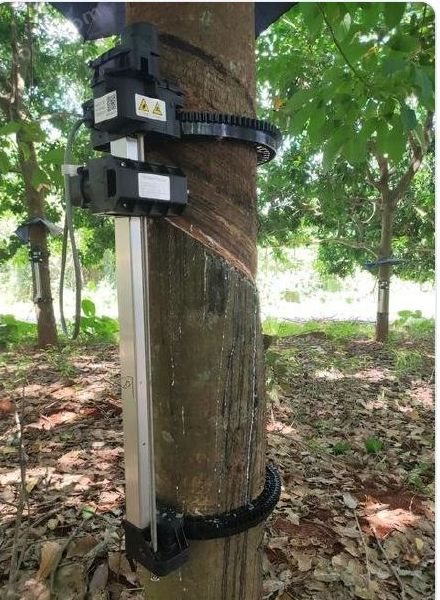
The machine is installed on the rubber tree and taps automatically; suitability depends on tree age, terrain and work organisation at your plantation.
- Standard model: one machine per tree, automatic tapping on a preset program, controlled from the app Product specification
- Enhanced model: adapted to different tree ages, trunk diameters and terrain; tapping parameters and structure are customised by region Product specification
- Also known as the "embrace-type" machine in Chinese.
What are the specifications and how should they be read?
Specifications are product specifications for the models listed in the solution. Different projects may use models from different manufacturers; the actual choice follows project selection.
| Item | Value | Source |
|---|---|---|
| Time per tree (single cycle) | about 47 s | Product specification |
| Cut-depth control | 1.3 ± 0.2 mm | Product specification |
| Bark consumption / cutting angle | 1.2–1.8 mm / 22°–35° | Product specification |
| Net weight | 2.3 kg | Product specification |
| Design life | at least 8 years (design value; warranty is as stated in the contract) | Product specification |
| Blade life | up to about 500 cuts between sharpenings | Product specification |
| Planned adjustment | twice a year (a proposed maintenance schedule, negotiable per project; not a standard for all models) | Product specification |
| Gateway capacity | up to 500 machines per gateway | Product specification |
How to read 47 s: it is the time for one machine to tap one tree once. It is not the number of trees one machine serves per hour. The value lies in many machines working in parallel; the "70–90 trees per hour" figure on the machines page is a group-control figure, not a single-machine rate.
What does published research say about cut depth?
The machine is designed to control cut depth and reduce the risk of cambium damage. In one published test, a fixed-type machine with a profiling mechanism reached a cut-depth qualification rate of 91.77%, 12.51 percentage points higher than without it[4]. That is a result for a specific machine and test, not a product guarantee Published study. Actual cut-depth qualification and damage rates depend on the model, test method and on-site acceptance.
Does each machine need 4G/5G?
No. Machines are connected by a local LoRa group-control network. Once the on-site controller is online, users abroad can view and send authorised commands through the app; individual machines do not need 4G/5G Product specification. A 2026 field study of a LoRa network for fixed machine groups in a Danzhou rubber forest reported an average communication failure rate of 0.6% under normal and rainy weather[3]. See Does a rubber tapping machine need 4G/5G?
How does the rainy season affect operation?
An official notice advises installing rain guards before the rainy season with a tight seal, and suspending tapping on heavily affected stands[5]. Whether to tap again after rain follows the local tapping system and the advice of your agronomist.
How is a large group deployed and maintained?
- One worker can manage 100–200 machines (manual tapping: 60–80 trees per worker) Product specification
- Blades, charging and inspection follow the project maintenance plan.
- Warranty scope is as stated in the contract.
What does it cost and what changes the configuration?
Indicative price for the standard model is about RMB 500 per unit (per-unit retail, FOB, gateway quoted separately) Product specification. Total project investment is quoted according to plantation conditions. The following factors affect configuration and quotation:
| Factor | What it affects |
|---|---|
| Country and region | Tapping system, regulations, logistics and taxes |
| Cultivar and clone | Tapping parameters and cut settings |
| Tree age, trunk diameter and shape | Model choice (standard or enhanced) and mounting |
| Tapping system | Schedule and program settings |
| Terrain | Installation, access and network layout |
| Communication | Gateway and relay-node layout, internet access |
| Rainy season and wind | Rain guards, protection and inspection plans |
| Electric power | Charging arrangement |
| Local labour cost | Project economics and staffing plan |
Gateway, installation, transport and taxes are quoted separately. No universal payback figure is given.
Where do I start?
Tell us your plantation conditions and we will propose a configuration, ideally beginning with a pilot on your own trees. Compare with the mobile type: Tree-mounted vs ground-mobile; see also Autonomous Mobile Rubber Tapping Robot.
Send us the factors above and we will respond with a plan.
Frequently asked questions
What is a tree-mounted automatic rubber tapping machine?
It is a machine installed on one rubber tree that taps it automatically on a preset program: one machine per tree (product specification).
How long does one machine take per tree?
About 47 s for one tree in one cycle (product specification). The value comes from many machines working in parallel, not from one machine serving many trees per hour.
How much does it cost?
The indicative price of the standard model is about RMB 500 per unit (per-unit retail, FOB, gateway separate). Total project investment is quoted according to plantation conditions.
Does it work without 4G/5G?
Yes. A local LoRa group-control network connects the machines; each unit needs no 4G/5G (product specification). A LoRa network for fixed machine groups reported a 0.6% average communication failure rate in a Danzhou rubber forest [3].
Sources
Independent publications are cited for context only. They are research or official results, not specifications or guarantees for any particular product.
- A Novel Relay-Node Deployment Method Guided by Installation Heat for Fixed Rubber Tapping Machine Group in Rubber Forest. Agriculture 2026, 16(19), 2097. DOI 10.3390/agriculture16192097.
- Development of a fixed-type profiling depth control rubber tapping machine using ADAMS (Zhang et al.). Transactions of the CSAE, 2025. DOI 10.11975/j.issn.1002-6819.202503158.
- Ministry of Agriculture and Rural Affairs of China: notice on monitoring and control of rubber-tree secondary leaf fall and tapping-panel stripe canker (加强橡胶树季风性落叶病和割面条溃疡病监测与防治), 25 June 2026.
Related pages
- Autonomous Mobile Rubber Tapping Robot
- Tree-mounted vs ground-mobile: comparison
- Does a rubber tapping machine need 4G/5G?
- Request a plantation assessment
- Machines overview
Tell us your plantation conditions and we will recommend a configuration.