Harvesting Equipment

Tapping machines: handheld · tree-mounted · ground-mobile

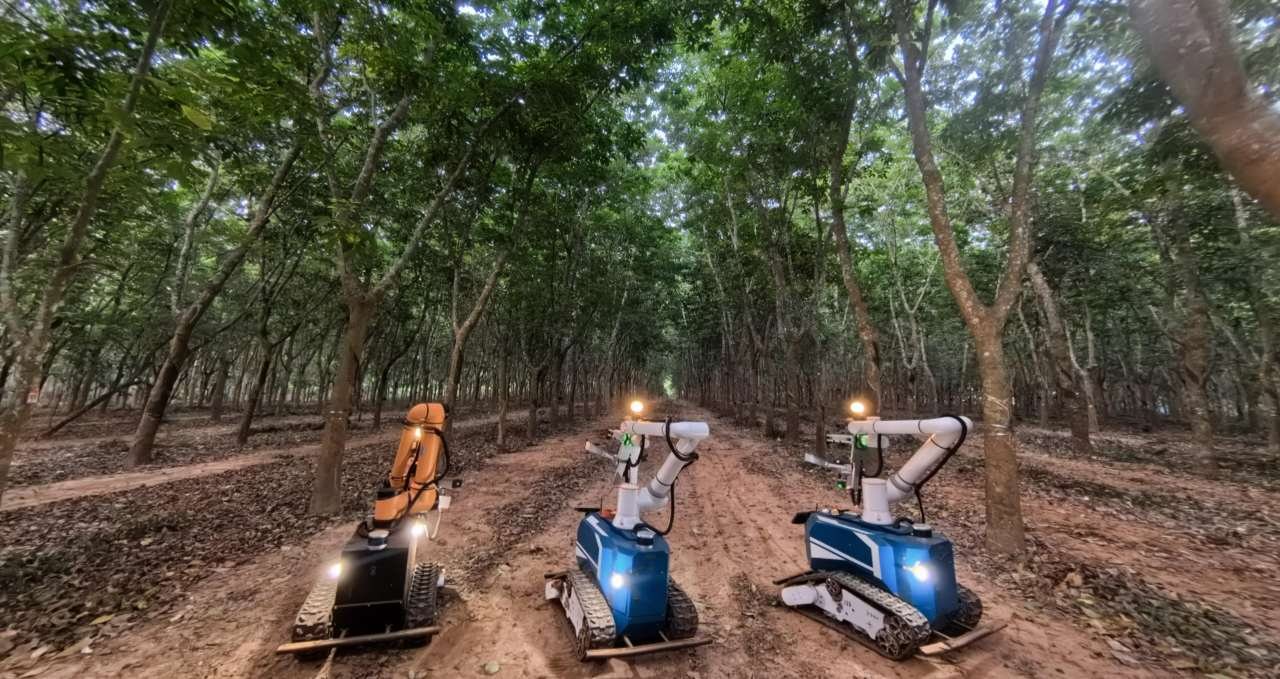
Tapping machines come in three categories by working form: handheld (electric tapping knife), tree-mounted (one machine per tree) and ground-mobile (autonomous tapping robot and auxiliary & transport platform). Multiple models cover different budgets and scenarios, and all plug into the smart-plantation management system of the managed agri-service.

5-10 s
Tapping per treeHandheld · electric tapping knife
47 s
Fully automatic tappingTree-mounted intelligent tapping machine
85.92%
Dry-rubber yield vs manual2026 independent field study · mobile robot · not a product guarantee [1]
275 TOPS
Onboard AI computeAuxiliary & transport platform · Robo-Ox
What are rubber tapping machines

A rubber tapping machine is a machine or robot that replaces or assists human tappers on rubber trees. They fall into three categories by working form — handheld (electric tapping knife), tree-mounted (one machine per tree) and ground-mobile (autonomous tapping robot and auxiliary & transport platform) — in ascending order of automation, all able to plug into the smart-plantation system.

Three Categories

Three working forms — one fits your plantation

HANDHELD

Electric Tapping Knife

Handheld and semi-automatic — your current tappers use it right away; 5-10 s per tree, 40% more efficient.

Details ↓
TREE-MOUNTED

Tree-Mounted Intelligent Tapping Machine

One machine “embraces” each trunk and taps automatically on a preset program; deployable across whole estates; Standard / Enhanced models.

Details ↓
GROUND-MOBILE

Autonomous Robot · Robo-Ox

Moves autonomously through the plantation: the tapping robot serves many trees (in field validation); the Robo-Ox is an auxiliary & transport platform, with functions confirmed per project.

Details ↓

Compare tree-mounted vs ground-mobile → No-GPS navigation · No 4G/5G

Intelligent harvesting equipment in the plantation
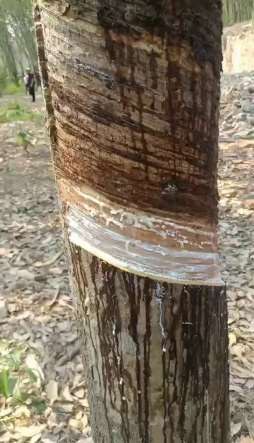
Cut face made with the electric tapping knife — clean, even lines and smooth latex flow

Electric Tapping KnifeHandheld · 3 years in the field

Handheld electric tapping

A handheld electric tapping tool that fixes the five problems of traditional knives — slow and tiring work, poor cut entry, blade deformation, curved cut faces and tree damage. A depth limiter and double-sided blade control the closing-cut depth, reducing the risk of tree damage; actual results depend on field use and acceptance.

Tapping time per tree5-10 s
Efficiency gain+40%
Battery per charge9+ hours
Market validation3 years
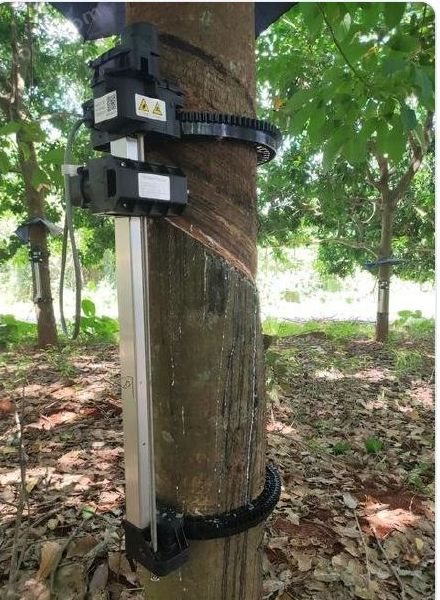
Product photo · tree-mounted intelligent tapping machine (one per tree)

Tree-Mounted Intelligent Tapping MachineStandard / Enhanced · customizable

One machine per tree

A fully automatic tapping machine mounted on each tree: a bionic tapping algorithm combined with force sensing, ultrasonic ranging and mechanical limits. A profiling and depth-control mechanism improves operating consistency and controls cut depth, lowering the risk of cambium damage; depth compliance rate, bark consumption and tree-damage rate depend on model, test method and on-site acceptance. A single precision motor drives the whole motion path. A mobile app can start clusters remotely; it is also the workhorse of the managed agri-service.

Time per tree per cutapprox. 47 s
Cut-depth control (product specification)1.3 mm ± 0.2 mm
Bark consumption / cut angle1.2-1.8 mm / 22°-35°
Group-control throughput70-90 trees/hour
Design life (design value)≥ 8 years
Net weight2.3 kg
Comms / call-throughLocal radio (LoRa) / >99%
Blade lifeup to 500 cuts between sharpenings
Charges per year (design value)≤ 2
Machines per gateway≤ 500

Basis of figures: 47 s is the time for one machine to tap one tree once; the value of the tree-mounted approach is many machines working in parallel. “70-90 trees/hour” is a group-control figure, not the number of different trees one machine serves per hour. Design life and charging frequency are design values; warranty and key-component coverage are defined by contract. Two scheduled calibration visits per year is a negotiable maintenance arrangement, not a standard for every model.

Enhanced model: an adaptive version for different tree ages, diameters and terrain — parameters and structure customized per region; depth compliance rate, bark consumption and tree-damage rate depend on model, test method and on-site acceptance.
Tree-Mounted Automatic Rubber Tapping Machine – Working Demonstration · 39 s
The machine is mounted on the rubber tree and performs the tapping cut automatically; actual suitability should be assessed against plantation conditions (tree age, terrain and work organization).
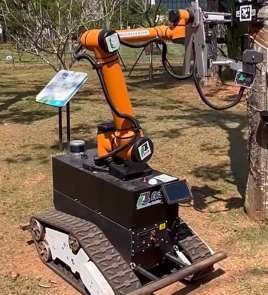
Product photo · autonomous tapping robot working between rows

Autonomous Tapping RobotGround-mobile · one machine, many trees

Autonomous navigation · field validation

An intelligent machine that navigates the plantation autonomously and performs tapping: robotics, automation control and AI combine for precise positioning, autonomous path planning and automatic tapping — aimed at reducing heavy labor and night-work risk. A one-machine-many-trees approach may reduce the number of devices per tree; the actual cost advantage depends on road conditions, effective trees per machine, tapping cycle, maintenance cost and workable days per year, so we recommend an on-site plantation test and an investment calculation first. Extensions such as latex collection or spraying are confirmed per project.

Working modeNight work · field validation
Validation statusField validation stage: independent study results on the comparison page
CoverageOne machine, many trees
Bark / depthConfigured and accepted per project
RelocationCompact · works across zones
System accessSmart-plantation dispatch

Current validation and improvement priorities: in an independently published 2026 field study the mobile robot reached a tapping depth compliance rate of 34.8% (manual 80%), which needs further optimization [1]; tapping was postponed in case of rain [1]. Configuration, quotation and delivery terms are set after a plantation assessment.

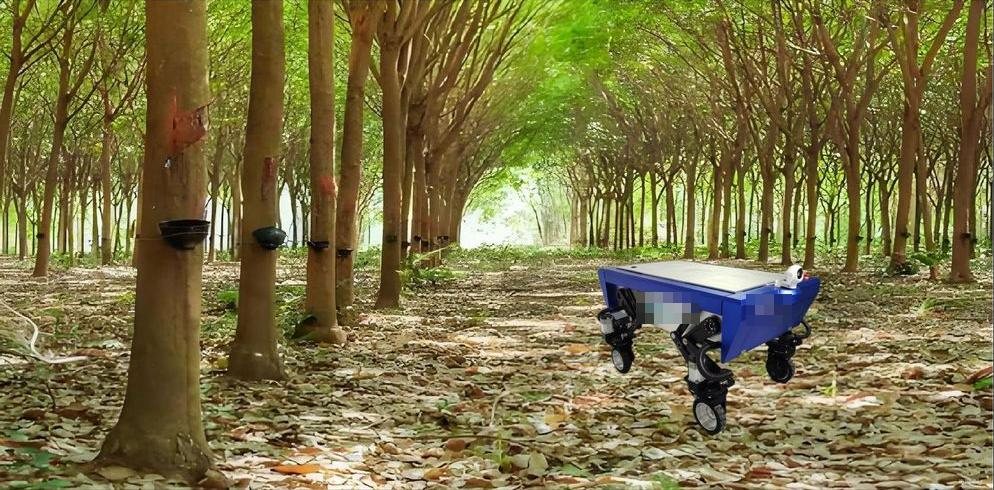
Product photo · balance robot (Robo-Ox)

Balance Robot · Robo-OxAuxiliary & transport platform · customizable

Auxiliary & transport platform · wheel-leg, for complex terrain

A ground-mobile auxiliary and transport platform — distinct from the autonomous tapping robot — designed for complex plantation terrain: it can support inspection and in-estate transport, with swappable end tools for more uses, customized per region and tree variety. Functions linked to tapping machines are confirmed per project; it should not be understood as automatically completing tapping, latex collection and transport after purchase.

AI compute275 TOPS
Environment scan360° / 50 m / ±2 cm
DriveFour independent legs + wheels, 10 km/h
Obstacle / slope30 cm / 30°
Payload / weight150 kg / <200 kg
BatteryDual 100 Ah · 8 h+
Arm6 DOF · ±1 mm
PositioningSLAM / 5G / WiFi6

All three categories plug into the smart-plantation management system (part of the managed agri-service) — see Agri-Service · Smart Plantation.

Manual vs Machine

Manual tapping vs the tree-mounted machine

ComparisonManual tappingTree-mounted machine
Time per tree—47 s (one tree, one cut; Product specification)
Managed per worker60-80 trees100-200 machines (product specification)
Labor cost—Depends on local wages and project configuration; requires project calculation
Dry rubber output100% (baseline)Requires project validation; no blanket commitment
Working hoursPre-dawn manual work, higher riskCan run automatically in set time windows; rain stoppage and severe-weather safety policy agreed per project
Digital management—Fully online and traceable

Yield, cost and attendance depend on model, tree condition, climate and work organization, and should be verified through an on-site plantation test.

Which One

Which category fits my plantation?

How to choose — step 1: match your situation

  • Tappers still available, want quick gains: handheld electric tapping knife — lowest cost, works day one
  • Mature standardized estate, done with hiring: tree-mounted machines at scale
  • Good roads, fewer devices per tree preferred: ground-mobile autonomous robot, one machine for many trees (field validation stage — test on site first)
  • Slopes and heavy transport: assess the Robo-Ox auxiliary & transport platform; linked functions confirmed per project
  • Don't want to buy or operate anything: see managed agri-service — no direct equipment purchase by the owner; costs and responsibilities defined by contract

Reference pricing

Tree-mounted intelligent tapping machine: RMB 500 / unit
Per-unit retail · FOB · gateway priced separately

Total project investment is assessed and formally quoted according to plantation conditions (country, clone, tree condition, tapping system, terrain, communications, climate, labor cost); mobile robots are quoted per project. Volume orders and custom models are quoted per solution.

Request a plantation assessment →

Request a quote
FAQ

Frequently asked questions

Tree-mounted or ground-mobile — which should I choose?

Tree-mounted machines (one per tree) can blanket a whole estate — best for mature, standardized plantations. The ground-mobile autonomous robot serves many trees per machine and is in field validation and customized deployment; a one-machine-many-trees approach may reduce the number of devices per tree, but the actual cost advantage depends on road conditions, effective trees per machine, tapping cycle, maintenance cost and workable days per year. Both plug into the smart-plantation system and can be mixed. See the comparison page and request a plantation assessment.

How many machines can one worker manage?

Per product specification, one worker can manage 100-200 tree-mounted machines (a manual tapper handles about 60-80 trees). A mobile app can start clusters remotely. Actual figures depend on terrain, networking and work organization.

Does it work without network coverage?

Yes. No 4G/5G signal is needed for a properly configured local LoRa group-control system; individual machines do not need 4G/5G. If the on-site controller has internet access and a secure app connection, overseas users can monitor and send authorized commands. One gateway serves up to 500 machines. Details and sources →

How often do batteries and blades need attention?

Per product specification (design values), the tree-mounted machine needs at most 2 charges per year with ≥85 no-load runs of reserve; blades last up to about 500 cuts between sharpenings. Two scheduled calibration visits per year is a negotiable maintenance arrangement, not a standard for every model; warranty and key-component coverage are defined by contract. The electric knife runs 9+ hours per charge.

Can it tap old or irregular trees?

Choose the Enhanced model: adapted for different tree ages, diameters and terrain, with parameters and structure customized per region; depth compliance rate, bark consumption and tree-damage rate depend on model, test method and on-site acceptance.