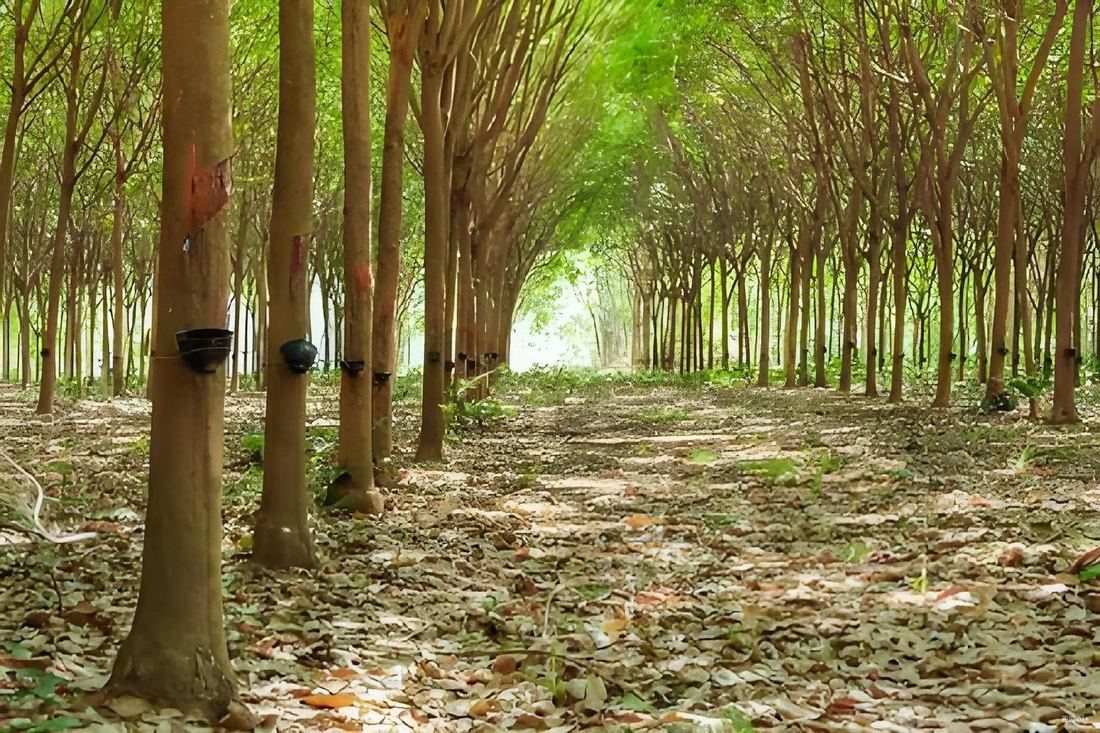
Intelligent solutions for the
entire natural-rubber value chain
Jinkun International Technology (Guangzhou) Co., Ltd. is a system integrator of rubber tapping robots and intelligent rubber factories, providing plantations and rubber processors worldwide with one-stop solutions covering intelligent tapping equipment, deep-processing lines, digital operations and managed agri-services.
Jinkun International Technology (Guangzhou) Co., Ltd. is a system integrator of rubber tapping robots and intelligent rubber factories: it integrates world-leading harvesting equipment, deep-processing lines and digital technology, and as a single point of responsibility completes solution design, equipment supply, on-site installation, training and long-term after-sales — from tree to finished rubber, you deal with one company.
Harvest → Process → Operate → Service, delivered as one chain
Four business lines cover the full natural-rubber chain — tapping, collecting, managing, nurturing, processing and delivery. Buy a single machine or plan the whole chain.
Intelligent Tapping Equipment
Three categories: handheld (electric tapping knife), tree-mounted (one machine per tree) and ground-mobile (autonomous robot & Robo-Ox).
View tapping machines →Intelligent Rubber Factory
A 60,000-tonne deep-processing line: 17 core machines, a 21-step process, and about 60% less line labor.
View the factory →Digital Operations
The plantation-side smart-plantation system (part of the managed agri-service) linked with factory-side SCADA + MES — data traceable end to end.
View the smart plantation →Managed Agri-Service
Zero hardware cost for plantation owners: Jinkun brings equipment and a local team, paid annually or by latex revenue share.
View agri-service →Five industry-wide challenges, answered one by one
Public reporting puts labor at roughly 60% of the total input of a rubber tree, while the tapper workforce keeps ageing — hard to hire and expensive to keep. The same squeeze is hitting plantations from Hainan to Kerala.
| Pain point | What it looks like | Jinkun's answer |
|---|---|---|
| Tapper shortage & ageing | Skilled tappers retire faster than they are replaced; wages keep rising | Tapping equipment + managed agri-service |
| Dangerous night tapping | Pre-dawn work is exhausting and risky; young workers stay away | Autonomous robots tap at night, unattended |
| Inconsistent quality, tree damage | Uneven skill wastes bark, shortens tree life and cuts yield | 0.1 mm-level controlled tapping |
| High processing labor cost | Breaking, drying and packing are labor-intensive and inconsistent | 60,000-tonne unmanned processing line |
| No traceability | Plantation and factory data live apart; decisions run on gut feel | Smart plantation + SCADA/MES |
Industry background sources (Chinese): CNR (labor ≈ 60% of total input), People.cn, Aug 2026; Jinkun's measured figures are on each product page.
Numbers with clear attribution
Every figure is tied to the specific product or scenario it was measured in — never mixed, never inflated.
| Metric | Value | Product / scenario |
|---|---|---|
| Tapping time per tree | 5-10 s | Electric tapping knife (handheld) |
| Fully automatic tapping per tree | approx. 47 s | Tree-mounted intelligent tapping machine |
| Cutting precision | 0.1 mm level | Tree-mounted intelligent tapping machine |
| Machines managed per worker | 100-200 units | Tree-mounted machine (manual: 60-80 trees) |
| Robot-to-manual yield ratio | 93.58% / 86.93% / 93.75% | Managed agri-service, three measured zones |
| Annual line capacity | 60,000 t | Deep-processing line |
| Staff per shift | 46 → 18 | Gemas, Malaysia smart workshop |
| Labor cost reduction | >60% | Processing line (machine-for-man) |
Equipment and services proven across regions
Harvesting equipment and the agri-service model run in real plantations across multiple countries; the Gemas, Malaysia workshop is the industry's first AI-driven primary rubber processing facility.
China's main producing regions
Hainan, Guangdong, Yunnan — harvesting equipment and smart plantations
Southeast Asia
Malaysia, Cambodia, Vietnam — processing lines and equipment export
South America
Brazil and South America distributors serving the Americas
International customers
A Japanese conglomerate, a leading global tire group and other downstream players
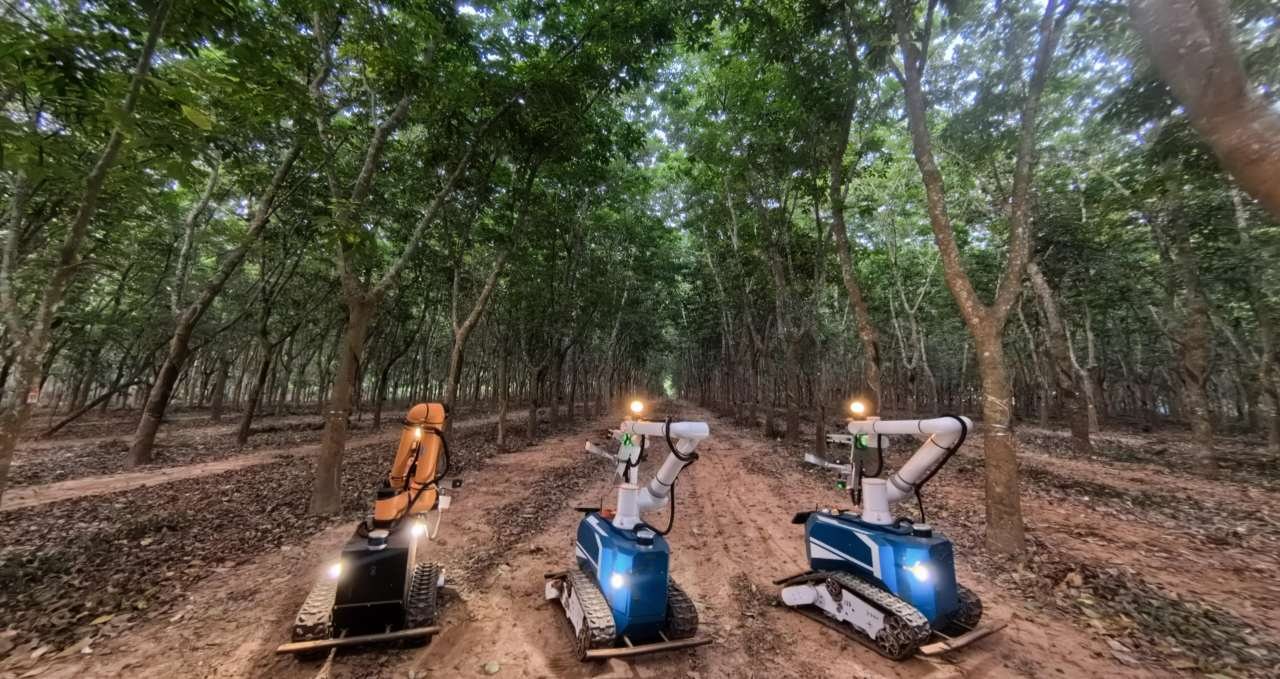
How much do tapping robots cost — and do they hurt the trees?
What kind of company is Jinkun?
Jinkun International Technology (Guangzhou) Co., Ltd. is a system integrator of rubber tapping robots and intelligent rubber factories. As a single point of responsibility it delivers solution design, equipment supply, on-site installation, training and long-term after-sales — customers deal only with Jinkun.
How much does a rubber tapping robot cost?
The indicative price of the intelligent tapping machine is RMB 500 per unit (per-unit retail, FOB, gateway priced separately; final pricing per solution quote). Plantations that prefer zero capital expenditure can choose the managed agri-service model instead.
Does machine tapping damage the trees?
No. The tree-mounted machine identifies the bark layer with force sensing, ultrasonic ranging and mechanical limits — 0.1 mm-level precision, cut depth 1.3 mm ± 0.2 mm, annual bark consumption within 11 cm. That is first-class tapper standard, protecting the tree better than uneven manual work.
How does robot yield compare with manual tapping?
Field measurements in managed agri-service projects show robot-to-manual yield ratios of 93.58%, 86.93% and 93.75% across three zones; the autonomous robot delivers 90%+ of manual yield. Machines never miss a shift, work at night and don't depend on hiring, so the overall labor-to-output ratio beats the traditional model.
Who fixes the equipment when it breaks?
Jinkun provides dual-track support (headquarters + local offices) plus cloud-based remote operations. Full lines carry a one-year warranty with free repair for non-human-caused failures and guaranteed spare parts. Under the agri-service model, Jinkun's own team handles all maintenance.
How much does a 60,000-tonne processing line cost, and how fast is payback?
For a line of roughly 60,000 tonnes per year, the indicative price is about RMB 15-17 million with a payback period of about 3-4 years. Every line is a custom project — final pricing follows the solution quote.
How to start working with Jinkun — three steps to delivery
- Step 1: Tell us where you arePlantation size/terrain, or your current line and target capacity — phone or WeChat
- Step 2: Get a plan and quoteJinkun surveys on site and returns a selection proposal with custom pricing — no cost before the quote
- Step 3: Delivery and productionSupply, installation, training through independent operation; one-year full-line warranty, one contact person throughout
From a single machine to a full-line EPC — start here
Tell us about your plantation or factory; a Jinkun project lead will work with you directly, from consultation to after-sales.
+86 135-1279-8328
No. 16 Keyun Road, Tianhe District, Guangzhou
Page updated: 2026-09-02