Autonomous Mobile Rubber Tapping Robot Field Validation & Customized Plantation Deployment
One ground-mobile robot travels through the plantation and taps many trees. This page states plainly where the technology stands: independent field results, product specifications, and the items that must be validated in a project.
Where does the mobile robot stand?
The mobile robot is at the stage of field validation and customized plantation deployment. It is quoted per project; no standard price is given. In a published 2026 field comparison of a mobile tapping robot (an independent study, not a specific supplied model), dry rubber output was 85.92% of manual tapping and the cut-depth qualification rate was 34.8% against 80% for manual tapping[1]. Scheduled unmanned start, return and charging, rainy-season working days and year-round continuity must be validated in a pilot.
Autonomous Mobile Rubber Tapping – Field Validation & Customized Plantation Deployment
The ground-mobile robot is positioned as customised equipment for plantation deployment: configuration and quotation follow plantation conditions, and a field pilot comes first Product specification.
What does the robot look like, and is there a video?
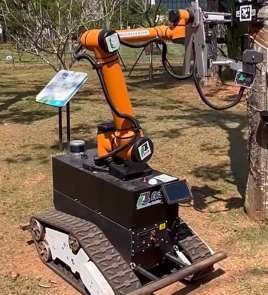
A working video of the mobile robot will be published once project material that can be made public is available. The tapping video on the machines page shows the tree-mounted machine, not the mobile robot.
What site conditions must be assessed?
Whether a mobile robot can work on your plantation needs to be assessed item by item. We assess:
- Passages between trees (row spacing and canopy)
- Slopes
- Obstacles (roots, ditches, branches, debris)
- Muddy ground and transfers between plots
- Tree age, trunk diameter and tapping system
What about scheduled operation and communication?
Scheduled tasks, return to base, charging and records of manual intervention need to be validated separately in a project pilot Project validation required. For communication, see Does a rubber tapping machine need 4G/5G?; note that the published LoRa network evidence concerns fixed machines[3], not mobile robots.
How does weather limit operation?
In the 2026 field comparison, tapping was postponed in case of rain[1]. An official notice advises rain guards and suspending tapping on heavily affected stands[5]. Stable tapping in rain is not promised. Round-the-clock automatic operation is not promised; shutdown, shelter and post-event inspection requirements for strong wind, thunderstorms and typhoons are agreed in the project.
What have field results shown, and what needs improving?
A 2026 comparison of 2 robots against 2 manual tappers, 1 June to 15 August, tapping every third day from 2 a.m.[1]:
| Item | Robots | Manual tapping |
|---|---|---|
| Trees tapped | 1,258 | 1,227 |
| Dry rubber output | 85.92% of manual | 100% (reference) |
| Time per tree, including moving | 37.04 s | 40.14 s |
| Cut-depth qualification rate | 34.8% | 80% |
The paper also reports better panel smoothness, incision-thickness control and wound condition than manual tapping[1].
The cut-depth qualification rate of 34.8% against 80% for manual tapping is the main gap shown by this study[1]. It is a result for the machines tested, not a product guarantee Published study; improving cut-depth control is a validation priority for any project.
What is published, what is Product specification, and what needs validation?
Specifications are product specifications for the models listed in the solution. Different projects may use models from different manufacturers; the actual choice follows project selection.
| Published studies | Product specification | Project validation required |
|---|---|---|
| Published study Field comparison with 2 robots vs 2 manual tappers[1]; navigation stopping error 5–6 cm (chassis)[2]; multi-sensor fusion positioning in a Danzhou rubber forest[6] | Product specification Autonomous navigation; night operation; one machine serving many trees; expandable to latex collection and spraying; connects to the smart-plantation system | Project validation required Scheduled unmanned start; return and charging; rainy-season working days; year-round continuous operation; maintenance cost |
How does a field pilot work?
- Site survey and conditions assessment (passages, slopes, obstacles, ground).
- On-site pilot on a defined plot with agreed acceptance items.
- Customised development where the pilot shows it is needed.
- Project deployment with an agreed maintenance and shutdown plan.
No price is given here: configuration and quotation follow the project.
Tell us your plantation conditions and we will propose a pilot plan.
Where is the Robo-Ox?
The Robo-Ox balance robot is an auxiliary and transport platform, shown separately on the machines page. See also the tree-mounted machine and the comparison page.
Frequently asked questions
Is the mobile rubber tapping robot a finished product?
It is at the stage of field validation and customized plantation deployment, quoted per project. No standard price is given (product specification).
How did the mobile robot perform against manual tapping?
In a 2026 field comparison of 2 robots and 2 manual tappers, dry rubber output was 85.92% of manual, time per tree including moving was 37.04 s against 40.14 s, and the cut-depth qualification rate was 34.8% against 80% [1].
Does it need GPS?
Published studies report navigation without satellite positioning; the 5–6 cm figure is the chassis stopping error, not cutter precision [2].
Can it tap in the rain?
Stable tapping in rain is not promised. In the 2026 field comparison, tapping was postponed in case of rain [1].
Sources
Independent publications are cited for context only. They are research or official results, not specifications or guarantees for any particular product.
- Development and Field Test for the Novel Intelligent Rubber-Tapping Robot with Advantages of Cost Effective and High Performance. Forestry and Agroforestry (ES Publisher), 2026.
- 基于Chebyshev启发与路径安全修正的割胶机器人胶林导航算法研究 (Chebyshev-inspired path planning with safety correction for rubber-tapping robot navigation in rubber forests). Journal of Hainan University (Natural Science), 2026. DOI 10.65658/j.hndk.2026022501.
- A Novel Relay-Node Deployment Method Guided by Installation Heat for Fixed Rubber Tapping Machine Group in Rubber Forest. Agriculture 2026, 16(19), 2097. DOI 10.3390/agriculture16192097.
- Ministry of Agriculture and Rural Affairs of China: notice on monitoring and control of rubber-tree secondary leaf fall and tapping-panel stripe canker (加强橡胶树季风性落叶病和割面条溃疡病监测与防治), 25 June 2026.
- 天然橡胶智能化生产团队在智能割胶机器人方向取得新进展 (multi-sensor fusion positioning for rubber-tapping robots under unstable GNSS, field-tested in a Danzhou rubber forest). College of Mechanical and Electrical Engineering, Hainan University, May 2026.
Related pages
- Tree-Mounted Automatic Rubber Tapping Machine
- Tree-mounted vs ground-mobile: comparison
- Can a tapping robot navigate without GPS/BeiDou?
- Does a rubber tapping machine need 4G/5G?
- Apply for a field pilot
- Machines overview
Tell us your plantation conditions and we will recommend a configuration.