Can't hire, can't invest big, can't manage yield —
we take over all three
Jinkun brings its own tree-mounted tapping equipment and builds a local team to run your plantation end to end, from inspection to latex delivery. Owners pay zero hardware cost — an annual fee or a latex revenue share — with contracted income no lower than the traditional model.
Managed agri-service is a model where Jinkun brings its own intelligent tapping equipment and builds a local team to take over a plantation's inspection, spraying and fertilizing, tapping, latex collection, delivery and equipment maintenance. The owner buys no equipment and hires no tappers — only supports deployment and road standardization — and pays an annual fee or a latex revenue share. A traditional forest becomes a digital plantation, risk is shared, and income stays no lower than the traditional model.
Buying equipment vs Jinkun managed agri-service
| Comparison | Traditional self-owned | Jinkun managed agri-service |
|---|---|---|
| Hardware investment | Owner buys all equipment | Zero hardware cost — Jinkun brings it |
| Labor | Owner hires and manages tappers | Jinkun trains and hires a local team |
| Scope | Usually tapping only | All six modules — tap, collect, manage, nurture |
| Risk | Equipment and yield risk on the owner | Risk shared; income ≥ traditional, contract-backed |
| Payment | One-time capital outlay | Annual fee or latex revenue share |
| Management | Experience-driven | Smart-model dispatch, data traceable |
From inspection to maintenance, six modules taken over together
Inspection
Daily patrols and growth monitoring — anomalies caught early
Spraying & fertilizing
Precise spraying and fertilizing by tree condition and season
Tapping
Tree-mounted machines tap automatically at night, dispatched in clusters
Latex collection
Scheduled collection that cuts latex loss and waiting
Delivery
Latex delivered on time to buying stations or factories, fully traceable
Equipment maintenance
Inspection, servicing and blade changes all handled by Jinkun's team
Two pillars: the rubber output model + automated tapping
A smart model schedules production precisely from tree condition, weather and yield history — beating the traditional labor-to-output ratio. Tree-mounted machines, cheap per unit and deployable across whole estates with unattended night work, are the workhorse of the service.
The smart-plantation management system, the service's digital backbone
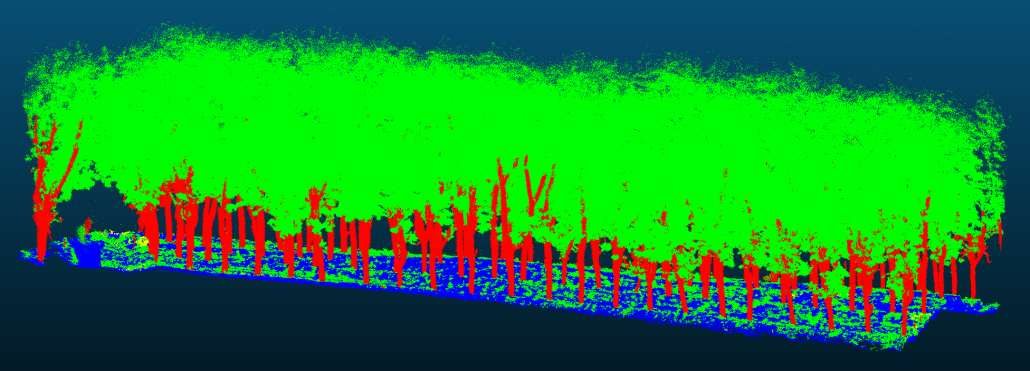
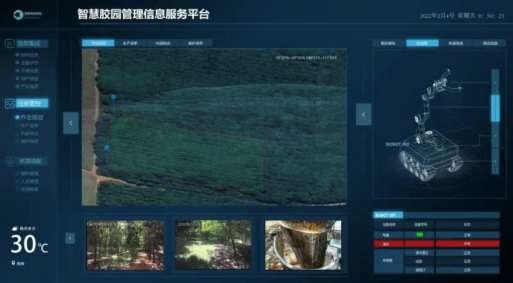
The “smart-model dispatch” of the agri-service runs on this system: 3D tree scanning builds a digital registry of every tree and audits plantation assets; tapping, collecting, managing and nurturing are digitalized end to end, and yield data stays transparent — so revenue-share settlement is backed by data.
Robot coordination
Tree registry & distribution
Harvest planning
Tapping metrics
Latex traceability
Tapper management
Weather & soil monitoring
Patrol & drone surveying
Decoupled smart terminals with data linkage and multi-mode operation; all three categories of tapping machines plug in for unified dispatch, and the plantation links with factory SCADA/MES — data traceable from tree to bale.
Robot vs manual yield: real data from three measured zones
Side-by-side zones in the same plantation; robot yield ÷ manual yield:
Robot-to-manual yield ratio
Robot-to-manual yield ratio
Robot-to-manual yield ratio
Reading the numbers: per-session yield is about 87%-94% of manual, but machines never miss a shift, work at night and don't depend on hiring; with smart-model dispatch the full-year labor-to-output ratio beats the traditional model, and owner income is contract-guaranteed to be no lower than traditional.
From survey to settlement in four steps
- Step 1 — on-site surveyAssess tree age, density, terrain and road conditions to scope the service
- Step 2 — plan & contractChoose annual fee or revenue share; income ≥ traditional, in writing
- Step 3 — deploy & trainRoad standardization support, equipment rollout, local team trained and hired
- Step 4 — operate & settleSmart dispatch runs continuously; yield data transparent, settled as agreed
Who it's for
- Contiguous estates struggling with hiring and an ageing workforce
- Owners unwilling to make a large one-time equipment investment
- Owners who want professionals to run the estate while they watch the returns
- Abandoned or under-managed forests whose owners want the asset working again
What we need from you
- Support for equipment deployment and in-estate road standardization
- Contiguous scale preferred; very small or scattered plots assessed first
- Acceptance of data-based yield metering and transparent settlement
Final conditions follow the on-site survey — tell us your plantation's location and size and Jinkun will arrange an assessment.
Frequently asked questions
What does the plantation owner pay?
Zero hardware cost — no equipment purchase. Owners support deployment and road standardization, then choose an annual one-time fee or a latex revenue share; risk is shared.
Will my income be lower than hiring tappers myself?
The contract guarantees income no lower than the traditional model. Measured yield ratios are 93.58% / 86.93% / 93.75%, but machines never miss a shift, work at night and don't depend on hiring — the overall labor-to-output ratio wins.
What kind of plantation is suitable?
Contiguous estates of scale that struggle to hire and can support road standardization; very small, scattered or road-inaccessible plots need an on-site assessment first.
Is the team local or brought in?
Jinkun trains the team and hires locally first — lowering cost and creating local jobs.
Buy equipment or choose the service — which is better value?
It depends on capital and appetite for operations: to build your own team long-term, see tapping machines (intelligent tapping machine indicatively RMB 500/unit); to stay hands-off with no equipment risk, choose the managed service. Many owners pilot a small zone first, then scale.
Page updated: 2026-09-02